The Demand Curve Faced by a Pure Monopoly Is
The demand curve faced by a pure monopolist. Asked Jul 14 2016 in Economics by CarmensitaMX.
Pure Monopoly Demand Revenue And Costs Price Determination Profit Maximization And Loss Minimization
Calculate the Marginal Cost at Q.
. May be either more or less elastic than that faced by a single purely competitive firm. 3 Explain why the marginal revenue is equal to the price in pure competition but not in monopoly. Which of the following statements is a major criticism of a pure monopoly as a source of allocative inefficiency.
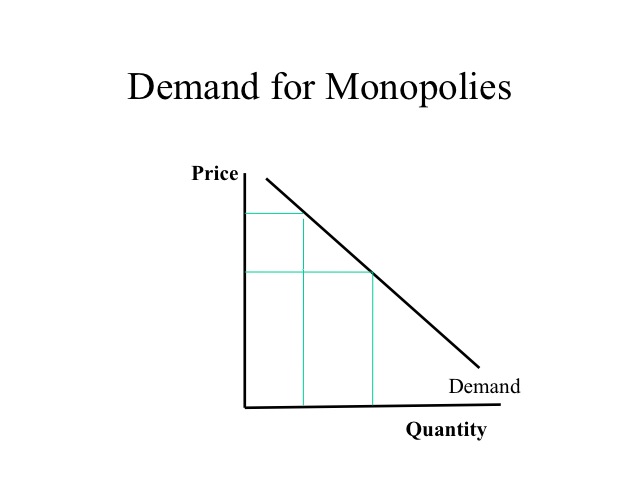
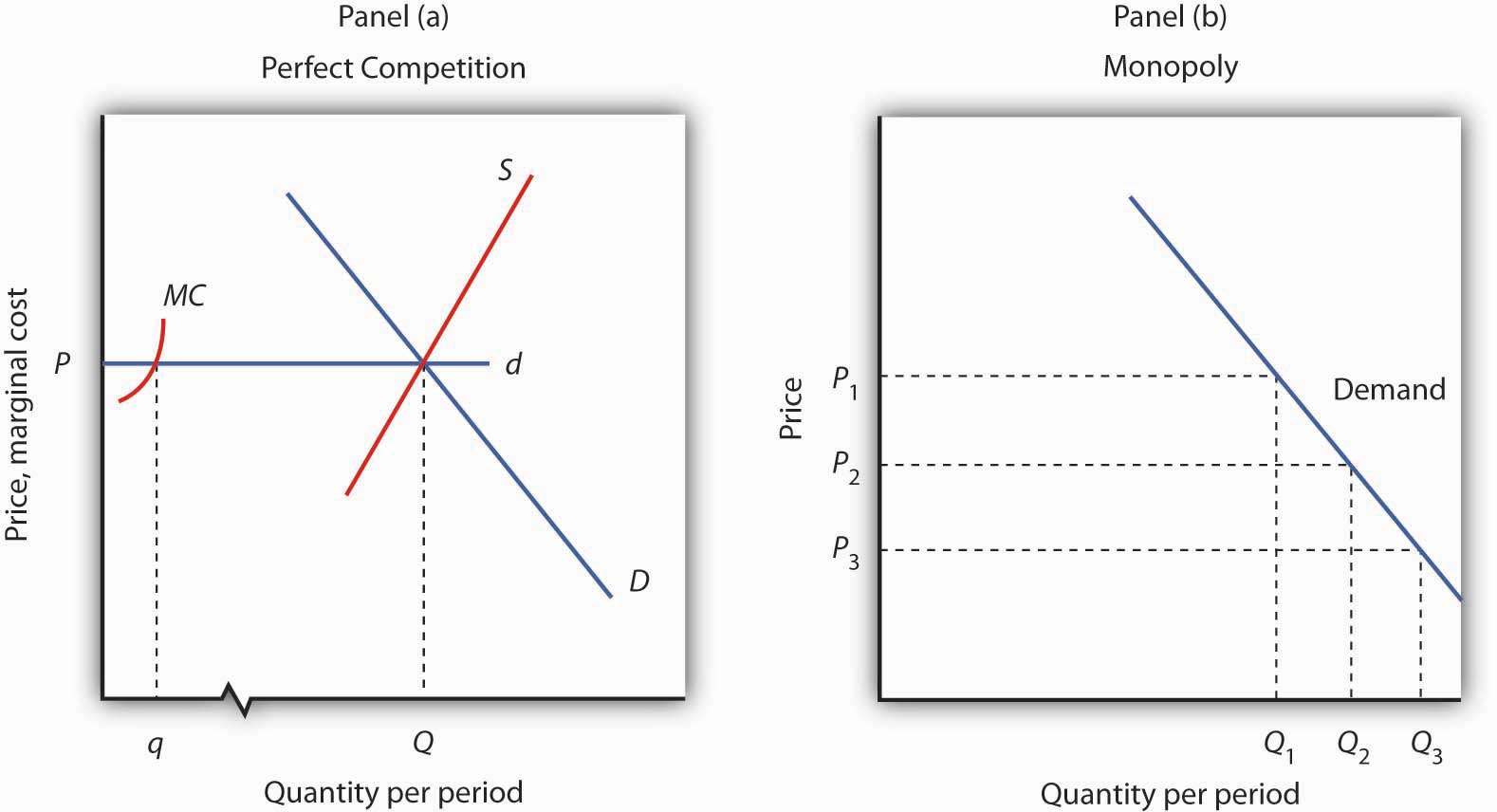
The demand curve faced by a pure monopoly is _____. Has the same elasticity as that faced by a single purely competitive firm. Therefore the demand curve for a monopolistic firm takes a downward slope whereas that of a perfectly competitive firm is horizontal Arnold 2014.
Change in total revenue change in quantity. Perfectly inelastic perfectly elastic. Has the same elasticity as that faced by a single purely competitive firm.
B is perfectly inelastic. Demand Curve Facing the Monopolist. Demand faced by a pure monopoly is____.
A pure monopoly fails to expand output to the level where the price of an additional unit is just equal to its marginal cost. See answer 1 Best Answer. It does not have to take the given price.
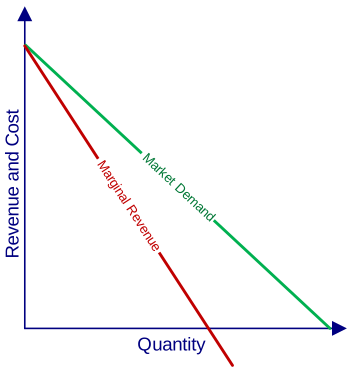
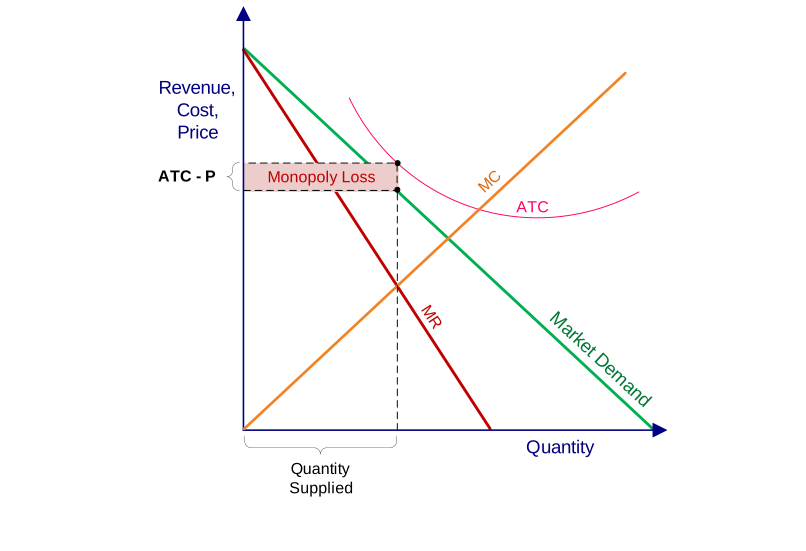
Describe the demand curve facing a pure monopoly and how it differs from that facing a firm in a purely competitive market. The Demand Curve intercepts the x-axis twice as far down the x-axis as where the Marginal Revenue curve intercepts the x-axis. The demand curve faced by a pure monopolist.
A non discriminating monopolist determined the demand curved and ultimately determined the price. 4 Use the chart to solve the following. The demand curve faced by a pure monopoly is _____.
A is the same as its marginal revenue curve. Is less elastic than that faced by a single purely competitive firm. C lies below the marginal revenue curve.
Suppose a pure monopolist is faced with the demand schedule. Demand curve faced by Nuclear plant a monopoly shall be _____ and for a wholesaler in flower market it will be _____ a. The demand curve faced by a pure monopolist is of downwardsloping in shape.
Asked Jan 12 2020 in Economics by doctor_who. Inelastic perfectly elastic b. Because the monopolist is the markets only supplier the demand curve the monopolist faces is the market demand curve.
D is the market demand curve. May be either more or less elastic than that faced by a single purely competitive firm. May be either more or less elastic than that faced by a single purely competitive firm.
Use the following graph to answer the next question. May be either more or less elastic than that faced by a single purely competitive firm. Perfectly elastic inelastic d.
The demand curve faced by a non discriminating pure monopoly is same as the industry demand curve as the monopoly facing the demand curve of the industry in the form of the downward sloping demand curve so that the monopolist increased its output demand. A pure monopoly has a perfectly elastic demand curve a pure monopolys marginal revenue curve is below its demand curve Many people believe that pure monopolies charge any price they want to without affecting sales. The demand curve faced by a pure monopolist.
Elastic perfectly elastic c. Downward sloping indicating that higher quantities are demanded at lower prices lower Q are demanded at higher prices. The change from the old demand curve to the new demand curve shown in the table represents a.
It is downward sloping because of the Substitution Effect the Income Effect and the Law of Declining Marginal Utility. 1 List the five characteristics of pure monopoly. Is less elastic than that faced by a single purely competitive firm.
Explain why the marginal revenue is equal to the price in pure competition but not in monopoly. Derived by vertically summing the buyers individual demand curves. If the government regulated the pure monopoly and made it set a normal profit price what price and quantity of output levels would we observe in the short run.
Compute marginal revenue when given a monopoly demand schedule. The demand curve that the monopolistic firm faces is the market demand curve. It can search the market demand curve to find the price that maximizes its.
For a pure nondiscriminating monopolist marginal revenue is less than price because. Asked Aug 6 2018 in Economics by lrshen. At its profit-maximizing output a pure nondiscriminating monopolist achieves.
The same as the industrys demand curve. The demand curve faced by a pure monopolist. The Demand Curve for a Monopolistic Market is of the same form as a regular Demand Curve.
The demand curve faced by a pure monopoly is _____. Is more elastic than that faced by a single purely. Is less elastic than that faced by a single purely competitive firm.
You will recall that the market demand curve is downward sloping reflecting the law of demandThe fact that the monopolist faces a downwardsloping demand curve implies that the price a monopolist can expect to receive for its output will not remain. The demand curve faced by a pure monopolist Multiple Choice o is more inelastic than that faced by a single purely competitive firm. More elastic than the demand curve faced by a perfectly competitive firm.
2 Describe the demand curve facing a pure monopoly and how it differs from that facing a firm in a purely competitive market. O has the same elasticity as that faced by a single purely competitive firm. The demand curve faced by a non-discriminating pure monopoly is the same as the industrys demand curve A non discriminating pure monopoly must decrease the price on all units of a product to sell more units.
Econ 150 Microeconomics
10 2 The Monopoly Model Principles Of Economics
Pure Monopoly Demand Revenue And Costs Price Determination Profit Maximization And Loss Minimization


Comments
Post a Comment